Showing posts with label Interesting. Show all posts

Tuesday, October 4, 2016

Rewriting Earth's Creation Story “We as a scientific community created an origin myth that has no more intellectual value than Genesis.”

From the Atlantic

...Ever since Apollo astronauts toted chunks of the moon back home, the story has sounded something like this: After coalescing from grains of dust that swirled around the newly ignited sun, the still-cooling Earth would have been covered in seas of magma, punctured by inky volcanoes spewing sulfur and liquid rock. The young planet was showered in asteroids and larger structures called planetisimals, one of which sheared off a portion of Earth and formed the moon. Just as things were finally settling down, about a half-billion years after the solar system formed, the Earth and moon were again bombarded by asteroids whose onslaught might have liquefied the young planet—and sterilized it.

Geologists named this epoch the Hadean, after the Greek version of the underworld. Only after the so-called Late Heavy Bombardment quieted some 3.9 billion years ago did Earth finally start to morph into the Edenic, cloud-covered, watery world we know.But as it turns out, the Hadean may not have been so hellish. New analysis of Earth and moon rocks suggest that instead of a roiling ball of lava, baby Earth was a world with continents, oceans of water, and maybe even an atmosphere. It might not have been bombarded by asteroids at all, or at least not in the large quantities scientists originally thought. The Hadean might have been downright hospitable, raising questions about how long ago life could have arisen on this planet.

“Although, if you go back to the original Greek Hell, Hades, you had to cross a river. It’s a cool, wet place. So maybe the joke is on us,” says Mark Harrison, a geologist at the University of California at Los Angeles...

...“So maybe the Hadean was not so Hades-like,” Reimink says.

Wadhwa says lunar samples and zircon samples are so limited that we still can’t paint a full picture of the Earth’s turbulent early days. In one sense, everyone might be a little bit right. Earth might have been nice and calm in the time between major impacts. Or some areas might have been molten, while some areas might have been solid and covered in oceans, she says.
One thing is clear, however: Harrison says there has never been any evidence to support the canonical hellish vision of magma lakes and tar-colored volcanos showered in fiery meteors.

“There is absolutely not a single scrap of observational evidence that requires that scenario ever took place. We as a scientific community created an origin myth that has no more intellectual value than 1 Genesis,” Harrison says. “Although we’re very quick to criticize those that operate on faith, that’s exactly what we did.”


Monday, June 20, 2016

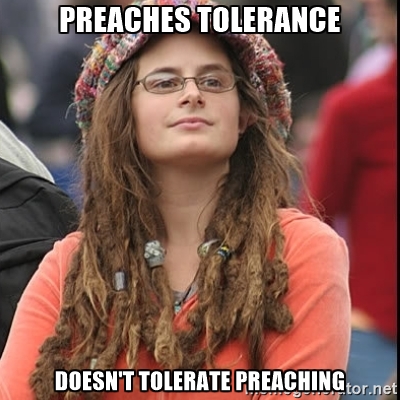
A Confession of Liberal Intolerance - (from a liberal)

From the New York Times

"We progressives believe in diversity, and we want women, blacks, Latinos, gays and Muslims at the table — er, so long as they aren’t conservatives. 
Universities are the bedrock of progressive values, but the one kind of diversity that universities disregard is ideological and religious. We’re fine with people who don’t look like us, as long as they think like us. 
O.K., that’s a little harsh. But consider George Yancey, a sociologist who is black and evangelical. 
“Outside of academia I faced more problems as a black,” he told me. “But inside academia I face more problems as a Christian, and it is not even close.” 
I’ve been thinking about this because on Facebook recently I wondered aloud whether universities stigmatize conservatives and undermine intellectual diversity. The scornful reaction from my fellow liberals proved the point... 
...Jonathan Haidt, a centrist social psychologist at New York University, cites data suggesting that the share of conservatives in academia has plunged, and he has started a website, Heterodox Academy, to champion ideological diversity on campuses. 
“Universities are unlike other institutions in that they absolutely require that people challenge each other so that the truth can emerge from limited, biased, flawed individuals,” he says. “If they lose intellectual diversity, or if they develop norms of ‘safety’ that trump challenge, they die. And this is what has been happening since the 1990s.” 
Should universities offer affirmative action for conservatives and evangelicals? I don’t think so, partly because surveys find that conservative scholars themselves oppose the idea. But it’s important to have a frank discussion on campuses about ideological diversity. To me, this seems a liberal blind spot. 
Universities should be a hubbub of the full range of political perspectives from A to Z, not just from V to Z. So maybe we progressives could take a brief break from attacking the other side and more broadly incorporate values that we supposedly cherish — like diversity — in our own dominions."

Friday, June 17, 2016

The day we discovered our parents were Russian spies - The Guardian

From the Guardian

"...If Tim and Alex’s story sounds eerily familiar to fans of The Americans, the television drama about a KGB couple living in the US with their two children, that’s because it’s partly based on them. The show is set in the 1980s, providing a cold war backdrop, but the 2010 spy round-up served as an inspiration. The show’s creator, Joe Weisberg, trained to be a CIA case officer in the early 1990s and, when I speak to him on the phone, tells me he always wanted to put family at the heart of the plot. “One of the interesting things I saw when I worked at the CIA was people lying to their children. If you have young children, you can’t tell them you work for the CIA. And then, at some point, you have to pick an age and a time, and they find out that they’ve been lied to for most of their lives. It’s a difficult moment.” 
When I meet Alex in Moscow, he has just finished watching the first season. (He had started on previous occasions, but found it too difficult; he and Tim joked that they should sue the creators.) His parents like the show, he tells me. “Obviously it’s glamorised, all this killing people and action everywhere. But it reminded them of when they were young agents, and how they felt about being in a strange new place.” Watching it, Alex says, has made him more curious: what set his parents off on this path, and why?..."

Friday, May 13, 2016

Two kinds of people - G.K Chesterton

“In truth, there are only two kinds of people; those who accept dogma and know it, and those who accept dogma and don't know it.”


Tuesday, May 3, 2016

The Smug Style in American Liberalism - Vox

From the Vox, "The Smug Style in American Liberalism"

"...Elites, real elites, might recognize one another by their superior knowledge. The smug recognize one another by their mutual knowing.
Knowing, for example, that the Founding Fathers were all secular deists. Knowing that you're actually, like, 30 times more likely to shoot yourself than an intruder. Knowing that those fools out in Kansas are voting against their own self-interest and that the trouble is Kansas doesn't know any better. Knowing all the jokes that signal this knowledge.
The studies, about Daily Show viewers and better-sized amygdalae, are knowing. It is the smug style's first premise: a politics defined by a command of the Correct Facts and signaled by an allegiance to the Correct Culture. A politics that is just the politics of smart people in command of Good Facts. A politics that insists it has no ideology at all, only facts. No moral convictions, only charts, the kind that keep them from "imposing their morals" like the bad guys do..."
"...Kim Davis was behind the times. Her beliefs did not represent a legitimate challenge to liberal consensus because they did not represent a challenge at all: They were incoherent, at odds with the Good Facts. Google makes every man a theologian.
This, I think, is fundamental to understanding the smug styleIf good politics and good beliefs are just Good Facts and good tweets — that is, if there is no ideology beyond sensible conclusions drawn from a rational assessment of the world — then there are no moral fights, only lying liars and the stupid rubes who believe them..."
Here's the conclusion I draw: If Donald Trump has a chance in November, it is because the knowing will dictate our strategy. Unable to countenance the real causes of their collapse, they will comfort with own impotence by shouting, "Idiots!" again and again, angrier and angrier, the handmaidens of their own destruction.
The smug style resists empathy for the unknowing. It denies the possibility of a politics whereby those who do not share knowing culture, who do not like the right things or know the Good Facts or recognize the intellectual bankruptcy of their own ideas can be worked with, in spite of these differences, toward a common goal.
It is this attitude that has driven the dispossessed into the arms of a candidate who shares their fury. It is this attitude that may deliver him the White House, a "serious" threat, a threat to be mocked and called out and hated, but not to be taken seriously.
The wages of smug is Trump.
"...The smug style, at bottom, is a failure of empathy. Further: It is a failure to believe that empathy has any value at all. It is the notion that anybody worthy of liberal time and attention and respect must capitulate, immediately, to the Good Facts.
If they don't (and they won't) you're free to write them off and mock them. When they suffer, it's their just desserts.
Make no mistake: I am not suggesting that liberals adopt a fuzzy, gentler version of their politics. I am not suggesting they compromise their issues for the sake of playing nice. What I am suggesting is that the battles waged by liberalism have drifted far away from their old egalitarian intentions.
I am suggesting that open disdain for the people they say they want to help has led them to stop helping those people, too.
I am suggesting that in the case of a Kim Davis, liberalism resist the impulse to go beyond the necessary legal fight and explicitly delight in punishing an old foe.
I am suggesting that they instead wonder what it might be like to have little left but one's values; to wake up one day to find your whole moral order destroyed; to look around and see the representatives of a new order call you a stupid, hypocritical hick without bothering, even, to wonder how your corner of your poor state found itself so alienated from them in the first place. To work with people who do not share their values or their tastes, who do not live where they live or like what they like or know their Good Facts or their jokes.
This is not a call for civility. Manners are not enough. The smug style did not arise by accident, and it cannot be abolished with a little self-reproach. So long as liberals cannot find common cause with the larger section of the American working class, they will search for reasons to justify that failure. They will resent them. They will find, over and over, how easy it is to justify abandoning them further.  They will choose the smug style.
Maybe the cycle is too deeply set already. Perhaps the divide, the disdain, the whole crack-up are inevitable. But if liberal good intentions are to make a play for a better future, they cannot merely recognize the ways they've come to hate their former allies. They must begin to mend the ways they lost them in the first place."

Friday, April 29, 2016

When I Consider How My Light Is Spent by John Milton

When I consider how my light is spent,
Ere half my days in this dark world and wide,
And that one talent which is death to hide
Lodged with me useless, though my soul more bent
To serve therewith my Maker, and present
My true account, lest He returning chide;
“Doth God exact day-labor, light denied?”
I fondly ask. But Patience, to prevent
That murmur, soon replies, “God doth not need
Either man’s work or His own gifts. Who best
Bear His mild yoke, they serve Him best. His state
Is kingly: thousands at His bidding speed,
And post o’er land and ocean without rest;
They also serve who only stand and wait.”

Sunday, August 9, 2015

A New Theory of Distraction - The New York Times

"Another source of confusion is distraction’s apparent growth. There are two big theories about why it’s on the rise. The first is material: it holds that our urbanized, high-tech society is designed to distract us. In 1903, the German sociologist Georg Simmel argued, in an influential essay called “The Metropolis and Mental Life,” that in the tech-saturated city “stimulations, interests, and the taking up of time and attention” turn life into “a stream which scarcely requires any individual efforts for its ongoing.” (In the countryside, you have to entertain yourself.) One way to understand the distraction boom, therefore, is in terms of the spread of city life: not only has the world grown more urban, but digital devices let us bring citylike experiences with us wherever we go.
The second big theory is spiritual—it’s that we’re distracted because our souls are troubled. The comedian Louis C.K. may be the most famous contemporary exponent of this way of thinking. A few years ago, on “Late Night” with Conan O’Brien, he argued that people are addicted to their phones because “they don’t want to be alone for a second because it’s so hard.” (David Foster Wallace also saw distraction this way.) The spiritual theory is even older than the material one: in 1874, Nietzsche wrote that “haste is universal because everyone is in flight from himself”; in the seventeenth century, Pascal said that “all men’s miseries derive from not being able to sit in a quiet room alone.” In many ways, of the two, the material theory is more reassuring. If the rise of distraction is caused by technology, then technology might reverse it, while if the spiritual theory is true then distraction is here to stay. It’s not a competition, though; in fact, these two problems could be reinforcing each other. Stimulation could lead to ennui, and vice versa...
...The way we talk about distraction has always been a little self-serving—we say, in the passive voice, that we’re “distracted by” the Internet or our cats, and this makes us seem like the victims of our own decisions. But Crawford shows that this way of talking mischaracterizes the whole phenomenon. It’s not just that we choose our own distractions; it’s that the pleasure we get from being distracted is the pleasure of taking action and being free. There’s a glee that comes from making choices, a contentment that settles after we’ve asserted our autonomy. When you write an essay in Microsoft Word while watching, in another window, an episode of “American Ninja Warrior”—trust me, you can do this—you’re declaring your independence from the drudgery of work. When you’re waiting to cross the street and reach to check your e-mail, you’re pushing back against the indignity of being made to wait. Distraction is appealing precisely because it’s active and rebellious.

Sunday, March 29, 2015

The Church of TED

A great TED talk is reminiscent of a tent revival sermon. There’s the gathering of the curious and the hungry. Then a persistent human problem is introduced, one that, as the speaker gently explains, has deeper roots and wider implications than most listeners are prepared to admit... 
...Twenty times a day you were supposed to tell yourself, as one translation put it, poetically, “Every day, in every way, I am getting better and better.” Prescriptions offered by many TED speakers are equally granular. The second most popular talk, measured by views on the TED site, is the one wherein Amy Cuddy of the Harvard Business School says that high-power poses — including standing up straighter, hands on hips — could “significantly change the way your life unfolds.”... 
...Perhaps the fact that there’s no intrusive voice from above makes this all more appealing than monotheism. Instead of sola scriptura, TED and its ilk offer more of a buffet-style approach to moral formation. I’ve talked to people who say they’ve happily dispensed with God, and don’t even find the general idea comprehensible. But a few, having announced they’re free of cant, spend many nervous hours assembling authority structures and a sense of righteousness by bricolage and Fitbit, nonfiction book clubs and Facebook likes."

The rest at the New York Times, The Church of TED 


Friday, March 13, 2015

Bach: A Passionate Life - John Eliot Gardnier

"If Monteverdi was the first composer to find musical expression for human passion, and Beethoven, what a terrible struggle it is to be human and aspire to be godlike, Mozart, the kind of music we'd hope to hear in heaven, Bach is the one who bridges the gap. He helps us to hear to voice of God but in human form, ironing out the imperfections of humanity in the perfections of his music."
- John Eliot Gardnier 

Sunday, January 18, 2015

Some Questions from David Berlinksi about Scientism - From Justin Taylor

David Berlinski—a secular Jew who is a philosopher and mathematician and is agnostic about God—asks and answers some questions in The Devil’s Delusion: Atheism and Its Scientific Pretensions (2011):
Has anyone provided a proof of God’s inexistence?
Not even close.
Has quantum cosmology explained the emergence of the universe or why it is here?
Not even close.
Have the sciences explained why our universe seems to be fine-tuned to allow for the existence of life?
Not even close.
Are physicists and biologists willing to believe in anything so long as it is not religious thought?
Close enough.
Has rationalism in moral thought provided us with an understanding of what is good, what is right, and what is moral?
Not close enough.
Has secularism in the terrible twentieth century been a force for good?
Not even close to being close.
Is there a narrow and oppressive orthodoxy of thought and opinion within the sciences?
Close enough.
Does anything in the sciences or in their philosophy justify the claim that religious belief is irrational?
Not even ballpark.
Is scientific atheism a frivolous exercise in intellectual contempt?
Dead on.

From Justin Taylor 

Monday, December 1, 2014

An Agnostic Manifesto - At least we know what we don't know

From Slate (Ron Rosenbaum) and a little excerpt from Albert Mohler
"...Agnosticism is not atheism or theism. It is radical skepticism, doubt in the possibility of certainty, opposition to the unwarranted certainties that atheism and theism offer. Agnostics have mostly been depicted as doubters of religious belief, but recently, with the rise of the "New Atheism"—the high-profile denunciations of religion in best-sellers from scientists such as Richard Dawkins and Daniel Dennett, and polemicists, such as my colleague Christopher Hitchens—I believe it's important to define a distinct identity for agnosticism, to hold it apart from the certitudes of both theism and atheism. 
I would not go so far as to argue that there's a "new agnosticism" on the rise. But I think it's time for a new agnosticism, one that takes on the New Atheists. Indeed agnostics see atheism as "a theism"—as much a faith-based creed as the most orthodox of the religious variety. 
Faith-based atheism? Yes, alas. Atheists display a credulous and childlike faith, worship a certainty as yet unsupported by evidence—the certainty that they can or will be able to explain how and why the universe came into existence. (And some of them can behave as intolerantly to heretics who deviate from their unproven orthodoxy as the most unbending religious Inquisitor.) 
Faced with the fundamental question: "Why is there something rather than nothing?" atheists have faith that science will tell us eventually. Most seem never to consider that it may well be a philosophic, logical impossibility for something to create itself from nothing. But the question presents a fundamental mystery that has bedeviled (so to speak) philosophers and theologians from Aristotle to Aquinas. Recently scientists have tried to answer it with theories of "multiverses" and "vacuums filled with quantum potentialities," none of which strikes me as persuasive... 
...Agnosticism doesn't fear uncertainty. It doesn't cling like a child in the dark to the dogmas of orthodox religion or atheism. Agnosticism respects and celebrates uncertainty and has been doing so since before quantum physics revealed the uncertainty that lies at the very groundwork of being... 
...But does that mean no *possible* evidence could decide it [existence or nonexistence of God]? That's a much harder argument to make. Huxley thought it was in principle Unknowable, but that's a side effect of too much German Romanticism in his tea. I can conceive of logically possible states of affairs in which a God is knowable, and I can conceive of cases in which it is certain that no God exists. (From John Wilkins
Wilkins' suggestion is that there are really two claims agnosticism is concerned with is important: Whether God exists or not is one. Whether we can know the answer is another. Agnosticism is not for the simple-minded and is not as congenial as atheism and theism are. 
The courage to admit we don't know and may never know what we don't know is more difficult than saying, sure, we know..."
And a little something from Mohler, a Baptist pastor. Regardless if you have or don't have (or don't know you have?) theological beliefs, he still makes an interesting comment.
"...But, in a fascinating twist, Rosenbaum suggests, contrary to Huxley, that the existence of God is not, in principle, unknowable. “I can conceive of logically possible states of affairs in which a God is knowable, and I can conceive of cases in which it is certain that no God exists.” 
Well, what might these “logically possible states of affairs” be? At this point in Rosenbaum’s essay, I feel cheated. How can he simply assert that he can conceive of some intellectual conditions for theism or atheism without naming them? 
In the end, Rosenbaum’s argument for a “new agnosticism” seems more rooted in attitude than in logic. He accuses both the New Atheists and classical theists of intolerance and a lack of intellectual humility. 
But, check out this rather striking sentence: “Agnosticism is not for the simple-minded and is not as congenial as atheism and theism are.” Ah, so by implication, theism and atheism might be for the simple-minded, but it takes a higher intellect to be agnostic. How humble. 
He continues: “The courage to admit we don’t know and may never know what we don’t know is more difficult than saying, sure, we know.” 
This is one of the central problems with agnosticism as a worldview. In claiming to take a humble approach, it actually ends up in a posture that is rather lacking in humility. The agnostic argues that we, as human creatures, are capable of deciding the intellectual terms when it comes to the big questions such as, first and foremost, the existence and possible knowledge of God..."

Saturday, November 1, 2014

Irrational Atheism (from a Rational Atheist)

"...I'm an atheist because I think of the universe as a natural, material system. I think of it, on the basis of my own extremely limited experience, as an infinitely replete but morally indifferent thing. It isn't bent on saving me, or damning me: It just is. I find comfort in that, as well as pain; wonder as well as loathing. That's my experience, and my atheism is a reflection of that experience. But it's not an argument; it's an interpretation. 
I have taken a leap of atheist faith. 
Religious people sometimes try to give proofs of the truth of their faith—Saint Thomas Aquinas famously gave five in his Summa Theologica. But for many people, belief comes before arguments, originating in family, social and institutional context, in desire and need. The arguments are post-hoc rationalizations. This can be true of atheism as well. For me, it's what I grew up with. It gets by in my social world, where professions of religious faith would be considered out of place. My non-faith is fundamentally part of how I connect with others and the world. 
The idea that the atheist comes to her view of the world through rationality and argumentation, while the believer relies on arbitrary emotional commitments, is false. This accounts for the sense that atheists such as Christopher Hitchens or Dawkins are arrogant: Their line of thinking often takes the form of disqualifying others on the grounds that they are irrational. But the atheist too, is deciding to believe in conditions of irremediable uncertainty, not merely following out a proof. 
Religious people have often offloaded the burden of their choices on institutions and relied on the Church's authorities and dogmas. But some atheists are equally willing to offload their beliefs on "reason" or "science" without acknowledging that they are making a bold intellectual commitment about the nature of the universe, and making it with utterly insufficient data. Religion at its best treats belief as a resolution in the face of doubt. I want an atheism that does the same, that displays epistemological courage... 
...William James—himself an eminent scientist—pointed out that science rests on emotional commitment. "Our belief in truth itself," wrote James, "that there is a truth, and that our minds and it are made for each other—what is it but a passionate affirmation of desire, in which our social system backs us up? We want to have a truth; we want to believe that our experiments and studies and discussions must put us in a continually better and better position towards it; and on this line we agree to fight out our thinking lives. But if a … sceptic asks us how we know all this, can our logic find a reply? No! certainly it cannot. It is just one volition against another—we willing to go in for life upon a trust or assumption which he, for his part, does not care to make." 
...By not believing in God, I keep faith with the world's indifference. I love its beauty. I hate its suffering. I think both are perfectly real, because I experience them both, all the time. I do not see any reason to suspend judgment: I'm here, and I commit. I'm perfectly sincere and definite in my belief that there is no God. I can see that there could be comfort in believing otherwise, believing that all the suffering and death makes sense, that everyone gets what they deserve, and that existence works out in the end. 
But to believe that would be to betray my actual experiences, and even without the aid of reasoned arguments, that’s reason enough not to believe."

Sunday, October 12, 2014

"The Apologist and Atheist in an Improbable Bond"

From the New York Times
"So commenced the unlikely friendship and intellectual partnership of the atheist and the apologist. Since then, their relationship has transpired through private emails and chats. Two months ago, though, it became public with the release of Professor Skeel’s book “True Paradox: How Christianity Makes Sense of Our Complex World.” 
Not only is Dr. Arsenault acknowledged in the book, and not only is he quoted in it as a “materialist friend of mine,” but the true paradox of “True Paradox” is that the volume might not have existed at all, or certainly would not exist in its present shape and voice, without the secular scientist as its midwife. And that odd reality is testament to a rare brand of mutual civility in the culture wars, with their countervailing trends of religious fundamentalism and dogmatic atheism... 
...“The thing that really sticks out with me,” Dr. Arsenault said, “is that in the culture wars, the rhetoric is acerbic on both sides. On the humanist side, there’s this tendency to view people of faith as not rational. And David is clearly rational. He’s just looked at the same evidence as me and come to a different conclusion.”

Saturday, September 6, 2014

"Richard Dawkins, what on earth happened to you?" - The Guardian

From the Guardian

"This is Dawkins in 2014: a figure of mockery, a man so convinced that he possesses God-like powers of omniscience that he can’t understand why everyone’s getting angry at him for pointing out the obvious. Why won’t we all just learn how to think, damn it! Then we could all live together in a peaceful society where nobody wears “bin liners”, and women shut up about sexual harassment... 
Sure, he wrote some pop science books back in the day, but why do we keep having him on TV and in the newspapers? If it’s a biologist you’re after, or a science communicator, why not pick from the hundreds out there who don’t tweet five or six Islamophobic sentiments before getting off the toilet in the morning? If you need an atheist, there are many philosophers, scholars of religion, and public intellectuals available who don’t refuse to acknowledge the existence of theology. 
Dawkins has been arrogant for years, a man so convinced of his intellectual superiority that he believes the one domain in which he happens to be an expert, science, is the only legitimate way of acquiring or assessing knowledge. All of his outbursts in recent years follow from this belief: he understands the scientific method, a process intended to mitigate the interference of human subjectivity in data collection, as a universally applicable way of understanding not just the physical world but literally everything else as well. Hence his constant complaint that those appalled by his bigoted vituperations are simply offended by clarity; feeble-minded obscurantists who cling to emotion, tradition or the supernatural to shield themselves from the power of his truth bombs. 
You don’t have to be religious to find this level of hubris baffling. In his review of The God Delusion, Terry Eagleton remarks: 
Imagine someone holding forth on biology whose only knowledge of the subject is the Book of British Birds, and you have a rough idea of what it feels like to read Richard Dawkins on theology. 
Dawkins’ narrowmindedness, his unshakeable belief that the entire history of human intellectual achievement was just a prelude to the codification of scientific inquiry, leads him to dismiss the insights offered not only by theology, but philosophy, history and art as well."


Thursday, July 10, 2014

The Myth of Sisyphus - Albert Camus

Good ol' Spark Notes

The central concern of The Myth of Sisyphus is what Camus calls "the absurd." Camus claims that there is a fundamental conflict between what we want from the universe (whether it be meaning, order, or reasons) and what we find in the universe (formless chaos). We will never find in life itself the meaning that we want to find. Either we will discover that meaning through a leap of faith, by placing our hopes in a God beyond this world, or we will conclude that life is meaningless. Camus opens the essay by asking if this latter conclusion that life is meaningless necessarily leads one to commit suicide. If life has no meaning, does that mean life is not worth living? If that were the case, we would have no option but to make a leap of faith or to commit suicide, says Camus. Camus is interested in pursuing a third possibility: that we can accept and live in a world devoid of meaning or purpose.


Monday, June 23, 2014

Irreligion is the opium of the people - G.K Chesterton

"It is only by believing in God that we can ever criticise the Government. Once abolish...God, and the Government becomes the God. That fact is written all across human history... the truth is that irreligion is the opium of the people. Wherever the people do not believe in something beyond the world, they will worship the world. But, above all, they will worship the strongest thing in the world."
G.K Chesterton


Monday, May 26, 2014

20 awesomely untranslatable words from around the world

At No.3, an Indonesian word!  

Jayus : "A joke so poorly told and so unfunny that one cannot help but laugh."

Also, Wabi-Sabi, from Japan “a way of living that focuses on finding beauty within the imperfections of life and accepting peacefully the natural cycle of growth and decay.”

The rest of the words here

Wednesday, April 23, 2014

Socratic Vs. Sophists Model

"On the one side sits the Socratic and reactive model, which seeks the truth through debate and dialogue, and in order to get there, takes its stand against the various faces of ignorance, stupidity or bad faith. On the other side sits the model of the Sophists, which makes no attempt to seek the truth, but seeks merely to seduce, to persuade, to effect an audience with almost physical intensity, and win over by the words alone"
- Luc Ferry "A Brief History of Thought"

Tuesday, February 25, 2014

Why we make bad decisions

"It is also crucial to ask probing questions not only of the experts but of ourselves. This is because we bring into our decision-making process flaws and errors of our own. All of us show bias when it comes to what information we take in. We typically focus on anything that agrees with the outcome we want"
- from New York TimesNoreena Hertz is a professor of economics at University College London and the authorof “Eyes Wide Open: How to Make Smart Decisions in a Confusing World.”